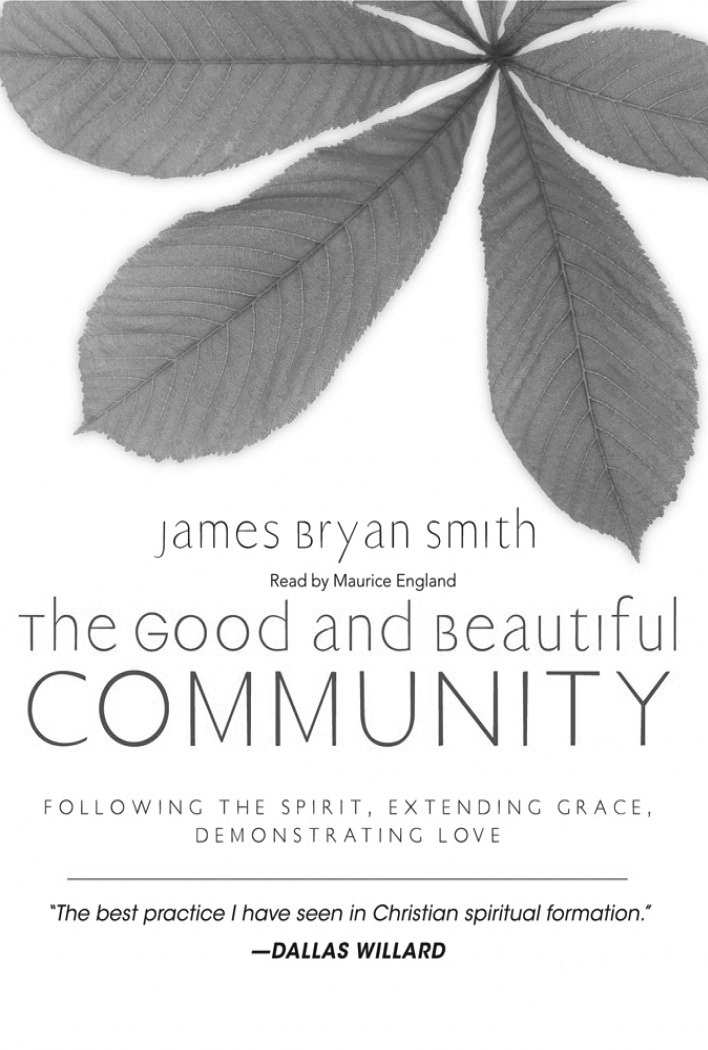
Smith, James Bryan. The Good and Beautiful Community: Following the Spirit, Extending Grace, Demonstrating Love. Downers Grover, IL: InterVarsity Press, 2010.
James Bryan Smith’s The Good and Beautiful Community is the third and final installment in his Apprentice Series, which, as Smith writes, “is designed to help people in their efforts to grow in Christlikeness” (9). The first two books focus on aligning “our thoughts about God . . . with Jesus” (The Good and Beautiful God) and performing a self-examination of our own souls (The Good and Beautiful Life). In The Good and Beautiful Community, Smith focuses on the logical next step: “loving our neighbor as ourselves” (10).
In his introduction, Smith offers a succinct summary of what he needs from those around him as he journeys to become an apprentice of Jesus:
I need to be reminded that as a follower of Jesus I am peculiar, in the best sense of that word. Peculiar, that is, to the world around me that does not live by the teachings of Jesus. My life is rooted in the eternal and strong kingdom of God; the roots of my life are in the future, safe and secure, which gives me the strength to live unselfishly, to strive for unity in the midst of diversity, to forgive even when it is not easy, to set my standards high, to live generously, to long to be worshiping in the house of the Lord and to be a witness of new life to a dying world. I need to be reminded and I need a community around me to help me remember who and whose I am, and what that means for my daily life (19).
While Smith specifically focuses on the church community in his book, the final sentence of this summary states well what each of our students may be looking for in our Christian schools: “a community around me to help me remember who and whose I am, and what that means for my daily life” (19). As the February issue of the CEJ reminded us, all of our students, including those wrestling with their own sexual identification, need a safe place to answer these essential questions.
One of the most effective elements of The Good and Beautiful Community, as well as the rest of the Apprentice Series, is Smith’s focus in each chapter on contrasting a “False Narrative” with a “True Narrative.” The false narratives are the narratives about God, Christian living, and our lives in Christian community that, while possibly holding elements of truth, do not fully depict the narratives that Jesus presented to those wishing to become his apprentices. The true narratives are the ones given to us by God through Jesus Christ. In chapter 3, “The Christ-Centered Community,” Smith contrasts the false narrative of “If we disagree then we must divide” (88) with the true narrative “Christ followers must remain unified” (89). He argues that those believing in the false narrative are guided by the fear that accepting those who differ will put members of their community in danger (88). He goes on to say, “Exclusion allows us the feeling that we are safe; we have kept the false teachers out; we have cast out of the fellowship the wolves in sheep’s clothing, and all is well” (88). While Smith sympathizes with these believers, recognizing that they mean well, he asserts, “It is misguided to think that we Christians are always going to agree on every issue” (89). Instead he sees the true narrative as expressing the following: “If you do not look, act, worship or believe as I do, but your heart beats in love for Jesus, then regardless of our differences, we can and must have fellowship with one another” (89, emphasis the author’s). Our Christian school communities are home to students, parents, and staff who differ in race, denomination, political party, and even sexual orientation. Our differences are many. However, Smith argues that what we hold in common, hearts beating in love for Jesus, is more powerful than our differences. As long as we can agree that Jesus Christ is Lord, we need to find ways to love one another in spite of what Smith calls the “nonessentials” (94).
Having illustrated and explained the differences between contrasting narratives, Smith challenges readers to engage in a “soul training” activity. (Learning what an apprentice does is no good if one does not put the lesson into practice.) Smith intends for his readers to cover one chapter a week and to engage in that chapter’s “soul training” activity during the week between chapters. In chapter 1, “The Peculiar Community,” Smith reminds us that we, as Christians, are peculiar, and that our “peculiarity comes from following (our) peculiar God” (38). In order to live into this true narrative, Smith encourages us, as part of our “soul training,” to “(1) spend time with God (2) do some peculiar things” (38). Fortunately for the reader, Smith always provides specific suggestions for completing this “soul training.” The “soul training” at the end of “The Peculiar Community” is titled “Two-by-Four” (38). Over the course of a week, Smith suggests that we spend two hours with God and engage in four “acts of peculiarity.” Many of us would refer to these peculiar acts as random acts of kindness, unselfish acts that require nothing in return. Imagine the impact an entire faculty committed to such peculiarity would have on a student body!
While Smith encourages readers to go through the Apprentice Series with others striving to grow as apprentices, I would have a hard time suggesting this book as a course of study for an entire faculty. This book is best studied in small groups that can meet regularly and spend time in thoughtful discussion, a tall order for busy teachers who already belong to numerous committees and groups between school and church involvement. Also, the book is best studied in the context of the first two entries of the trilogy. We need to first see God for who Jesus says God is, as well as who we are in God (not sinners saved by grace, but new creations alive in Christ). Once we understand that, we must learn how to live into our new identity (putting off the things of this world). Having accepted our new identities, we can learn how to live in community with other apprentices and would-be apprentices. Studying the third book without the other two provides an incomplete picture.
While I began my journey through the Apprentice Series on my own, I am finishing with a colleague who, through the process, has become a trusted friend. Over the course of a year, he and I have tried to meet weekly as we worked, and continue working, our way through Smith’s books. We intend to discuss one chapter a week, but often end up needing a couple of weeks to cover a chapter due to our short lunch break, the usual interruptions, and the in-depth conversations prompted by our reading. This may be the best approach for taking on this series in a school setting: two colleagues at a time, as they are able. Such a pairing provides accountability both for working through the material and for living as apprentices in our schools. As James Bryan Smith found out from his time with his accountability partner, well-known theologian Dallas Willard, “no matter who we are, no matter how deeply we live in the kingdom, we still need to be encouraged, admonished, and challenged to grow in Christlikeness; we need to be accountable to an encouraging community” (142). For those ready to be challenged, for those ready to grow as apprentices of Christ, Smith provides a thorough, thoughtful, and practical curriculum.
Mark Brink teaches English and coaches tennis at Unity Christian High School in Hudsonville, MI. He also serves on the editorial board of the CEJ.