I was drained. It had been an emotionally and mentally taxing class period. This lesson always was. Having experienced this lesson with students near the start of semesters past, I knew what I might expect. Some left class very perplexed. They wanted to have answers for our guest, but they rapidly realized they didn’t have any that would ultimately satisfy his questions. Others left angry, upset by the certainty and commitment of our guest’s convictions, which were so different from their own. Some left amused by the clever wit and arguments they had heard. Some simply went on with the rest of their day, nonplussed by what they had witnessed. Still others I needed to spend a few extra minutes with because they were visibly upset, even crying at their own feelings of frustration and at the realization of the ultimate destiny of our guest, my friend, given his faith commitment and ours.
You see, my friend is an atheist. And with the blessing of my principal, I invited him into my senior Reformed doctrine class at the start of the semester.
Let me tell you how I met him and how we became friends.
Meeting Richard
I was twenty-five years old. I grew up in a Christian home and was catechized in the Christian Reformed Church. A graduate of Holland Christian Schools, I publicly professed my faith in Christ as a young adult. Before becoming a Bible teacher, I worked as a cost accountant for a large office-furniture manufacturer in West Michigan. Shortly into my tenure at this company, I found myself part of a rather eclectic group of employees from around the company who gathered for an offsite, overnight, corporate culture-building training conference. Richard, one of my small group colleagues, used this provocative teaser to introduce himself as we each took a turn around the circle sharing our names, our positions in the company, and something interesting about ourselves: “Hi. My name is Richard. I work in computer programming, and I’m running for the job of God because I think I can do a lot better job of running this place than he is.”
I was stunned and bemused, if not just amused, by the tongue-in-cheek yet serious tone of Richard’s audacious statement. I wasn’t sure I should laugh, but I wanted to. What truly bothered me though was that I had no response. I did not know how to speak my faith to someone who brought such a bold challenge. So, intrigued, I smiled and listened some more as a smaller group of us lingered and talked with Richard beyond the official end of this introductory meeting.
Another coworker, fired up in her faith, pounced and took the offensive, challenging Richard’s assertions. He smiled and with witty rationalism, and not a little irreverence, refuted everything she had to say. This was not Richard’s first conversation about this nor were his thoughts and commitments lightly considered or off-the-cuff. He had rejected his childhood faith while at a public university when a professor challenged the class to believe only what they could rationally defend with their own eyes, ears, and minds instead of what someone had told them was true. Richard was convinced; Christian faith was irrational and of little use. Any faith, for that matter, had little to no value for Richard. His mind was his only arbiter of truth, right and wrong.
Little did I know that in my silence Richard was drawn to a Christian who didn’t have simple or prepackaged answers to launch back at him. To my surprise, a friendship with Richard emerged from this initial meeting, and there would be many, many more conversations around faith, the Bible, and Jesus for years to come; these conversations would challenge my faith and raise doubts that I had never considered before and wasn’t prepared to face. Through the grace of God, the encouragement of dear friends and mentors, and continual growth in my church and in my faith, the Spirit comforted, equipped, encouraged, and carried me through this time of challenge, question, and growth.
An Atheist Goes to Bible Class
When I went back to school and became a Bible teacher only a few years later, I was convicted that students in a Christian school, my Bible students, needed to be prepared to face the challenges, questions, and doubts they would undoubtedly encounter in their lives as high school students—and certainly as graduates in the workplace, public university, or Christian college, for that matter. I wanted to be there with them when they were first confronted with these challenges so that they did not feel alone. I wanted to accompany them on this journey, not because I had answers to every question or doubt that would arise but so that we could walk and grow together in our community of faith.
Richard became an annual guest in my Reformed doctrine classes for a number of years before moving out of state. He claimed not to enjoy the visits other than the intellectual challenge they brought to him. He knew he was asking students to consider a perspective so antithetical to their own that it could be painful. He saw their tears and unsettledness. This did move him. He acknowledged that he was not seeking converts as that entailed my students giving up everything they held hopeful, comforting, and meaningful for life and death. Yet he appreciated giving students the opportunity to examine their beliefs and faith.
One day before Richard moved away, I asked him over lunch if there was any possibility that he would be willing to write a summary of all the things he brought to my classes and students over the years. Richard was no strawman exhibit but rather a flesh-and-blood friend who caused me to wrestle more authentically with both my faith and my doubts. I did not want that opportunity to end for my students.
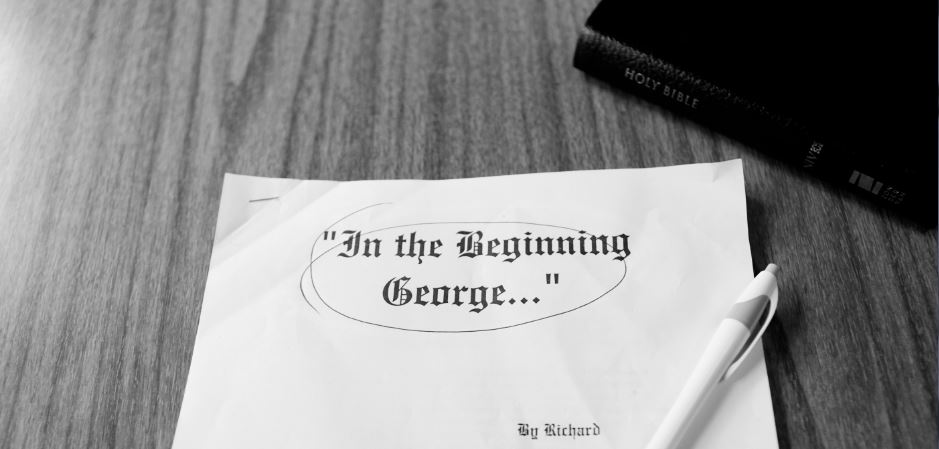
At first, he demurred at the idea. I said that I understood. But a few months later I received in the mail a large envelope carrying a nine-page, single-spaced essay from Richard outlining and summarizing his major objections to Christianity and to any religious faith commitment. He titled it, “In the Beginning, George.” One of Richard’s main contentions was that his fictitious god named George was as provable and defendable as the Christian God, which he went on to explain with his characteristic wit and clever reason. With this and many other arguments, Richard continued to provide a real and authentic challenge for even more students of mine in successive years.
Truths about Doubt
Through the many years of Richard’s visits and exposing students to his ideas, I became convicted of several important truths.
First, Richard never planted doubt in any serious way or created thoughts in my students’ minds that had never been considered before especially by those students who were wrestling already, or those who were ready to wrestle with their faith. Rather, Richard’s challenges brought to light and put to words some of the doubts and questions that students carried with them quietly, privately, in the dark and often with great fear. Doubt cowers in the dark. It troubles us most when we feel we are the only one to have ever thought such things. Doubt gives way to fear. We begin to think we are losing our religion, losing our faith. The truth is that doubt can be the catalyst, the fertilizer for growing one’s faith. When doubt is exposed to the light, its fear-inducing power is diminished and faith can grow.
Second, we learned together, my students and I, that it is always healthiest to face our doubts in community. We seldom do well to face the fear cast by our doubts alone. We are made for community. We belong, and, when I share my doubt, I find that I am not the only one asking these questions or wrestling with these doubts. Chuck DeGroat encourages us to “wrestle with each and every doubt. Speak it plainly. Share it with confidence. God is secure, and God is a much better listener than anyone you’ve ever known” (83). With confidence in a God who is not put off by our doubts, we find that we are surrounded by a catholic community of believers and saints, present and past, who share some of the very same questions and doubts that we have in our faith journeys. As with all things in the journey of the Christian life, we are not meant to walk the path alone.
Third, my students and I were comforted by the realization that doubt is not the opposite of faith, but rather an element of faith. By its very nature as described in Hebrews 11:1, faith is “confidence in what we hope for and assurance about what we do not see.” Even John Calvin acknowledges that “surely we cannot imagine any certainty that is not tinged with doubt, or any assurance that is not assailed by some anxiety” (562).
Faith and doubt go hand in hand by necessity. We are invited and empowered by the Holy Spirit to believe and live the Christian faith, which promises a reality beyond the confines of human reason alone. That is the deal.
An Invitation to Faith
My students and I would continue to wrestle with Richard’s challenges and ideas for the rest of the opening unit, and we often revisited them throughout the rest of the semester. We learned at times to doubt our doubts. We continued to wrestle with the nature of faith, even realizing that my friend was operating from a position of faith too. His commitment was to himself—to human reason—and his assumptions were grounded in his own capabilities and rationality as well as in the wash of collective human wisdom and experience. This was what he relied on to determine all things right and true.
This unit and its lessons often spilled over into before-school breakfasts and after-school coffees with individuals and small groups of students who wanted to talk more about what they were learning and experiencing. This also became the single experience I most often heard about and recalled gratefully with graduates when we would meet. God used this experience in their lives to grow their faith and their lives with him. It even comes up today with graduates (who are now parents) who I have the privilege to meet again when they enroll their preschooler at the school where I am now the principal. I am grateful for the opportunity I had as their teacher to accompany them on the pathway of faith for a little while.
On the journey with my students, each semester my desire, hope, and prayer for each of them was that they understand that faith, Christian faith with doubt and all, is an invitation to live. It is an invitation to a relationship, to live with Jesus, to take him at his word. The invitation of faith is to taste and see that God is good, that He is faithful even with our unfaithfulness, doubts, imperfections, pains—with all that we are. God is faithful, and He invites us to live our lives with and for Him, and to find Him to be faithful and true. And any doubt that Richard may have named and caused us to wrestle with is powerless to stand in the light and power of God’s faithfulness, grace, and goodness when we live in right relationship with him.
Contrary to my dear friend’s assertion, George is incapable and insufficient to do what God does by faith and by the presence of the Spirit.
Works Cited
Calvin, John. Institutes of the Christian Religion. Vol. 1. Philadelphia: Westminster Press, 1960.
DeGroat, Chuck. Falling into Goodness: Lenten Reflections. CreateSpace Publishing, 2017.
Rod Brandsen is the principal at Rose Park Christian Elementary School in Holland, MI. Always a Bible teacher at heart, having taught Bible at Holland Christian High School for many years, Rod loves to speak and encourage people in their faith, and Christian educators in the cause of Christian education.