Peter Baldwin is President of AMDG Architecture in Grand Rapids, Michigan, where he has worked for over 25 years. In the past 12 years the firm has worked on educational buildings for Christian educational institutions throughout the Midwest. Peter’s passion for his work stems from the belief that architecture has the power to build community and strengthen mission through the transformation of space.
The firm’s name, AMDG, stands for Ad Majorum Gloriam Dei—”To the greater glory of God.”
CEJ: What are some key principles for designing twenty-first-century learning environments? What things are exciting, new, or maybe challenging to people who have old models in mind?
PB: I think a building starts with vision and educational delivery or pedagogy. You know—how you believe learning happens, how instruction happens. I’m not an educator, so I don’t pretend to deeply understand the science, but I think understanding of the brain, how kids learn, different levels of instruction, and personalized learning are important. There was clearly, for a century plus, this idea that everybody learned in the same way, that everybody should be in the same space, that learning was predominantly one directional, usually in pretty formatted ways, and also that it was pretty siloed. Those were the ideas that actually drove our spaces to be these singular classrooms with long class corridors.
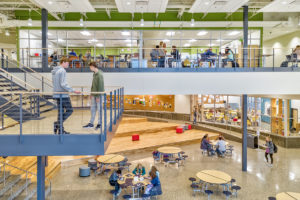
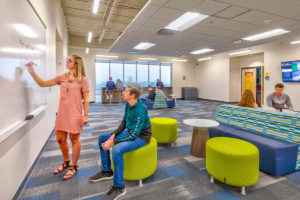
When we think about space and learning environments today, we know they need to be way more varied, and they need to serve different masters. Teachers today are better at disseminating information in different ways: peer-to-peer, small group, large group, using the digital world to inform learning and help display it. Because there are so many things you can do, schools demand much more from the space. It has to be flexible. If you’re interested in the technical side of it, I think a good physical space or school actually has to anticipate being mangled and changed and morphed, and so we’ve kind of looked at pretty wide-spanning structural systems and things that create more flexible space so the walls within it can be moved. The old model of a load-bearing wall supported the roof, but it also created really restrictive boxes that were hard to change. The new school has to provide bigger, agile spaces, because I can’t imagine schools will be the same twenty years from now.
Creating a variety of spaces and learning opportunities is another principle. At South Christian High School [in Caledonia, Michigan], one question we were asked was, “Where does the introvert go?” I think a twenty-first-century school creates different spaces for different learners and personalities. There are pull-outs. There are small groups. There are big groups. There are spaces for quiet reflection and for loud activity.
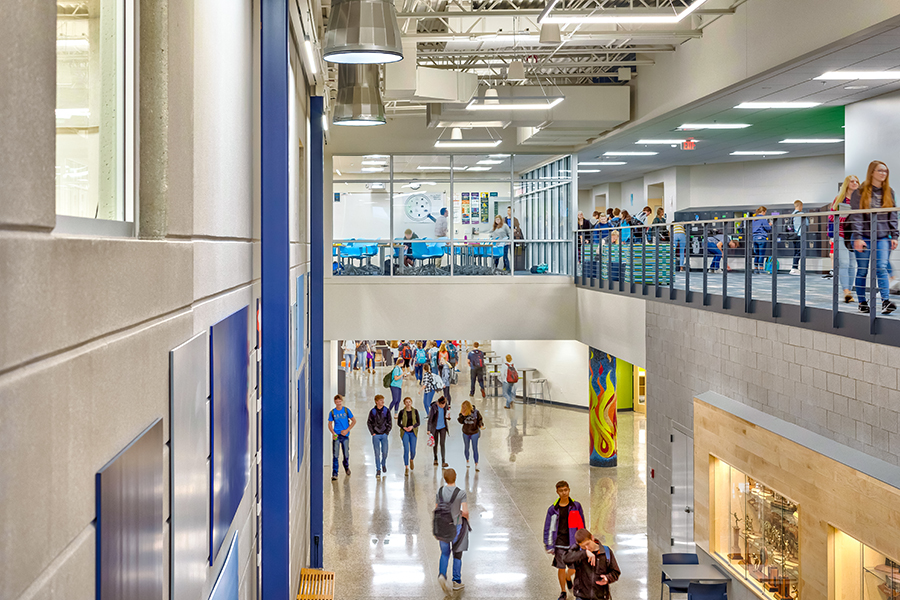
One of the things I loved about working with [educational consultant] Frank Locker on a number of projects, that I found most inspiring, was this idea of celebrating learning, making learning visible. So I think a twenty-first-century school exhibits and celebrates the learning that’s happening in it, admitting that it’s messy and it’s real and it’s good. And that includes everything from fine arts to the sciences.
Another principle is the idea of passive supervision. A great school provides fewer cameras and less obvious security but more visual connections that are meaningful enough so a teacher can kind of send people out to do work. In one of the high schools we worked on, the staff bathrooms were at the back of the kids’ bathrooms, so the kids always knew that staff could be walking through. That’s a pretty cool example of passive supervision. It’s not overbearing. It’s designed that way.
And that’s related to another thing I think is meaningful about a school: it should presume the value and dignity of people and of itself. It shouldn’t presume that students are animals that want to destroy things. If you give them beauty, you give them quality, and you give them the right boundaries, instead of building a prison with block walls, and I think kids actually will grow to understand and appreciate those things. A great school is a place that’s trying to inspire. In a Christian school, you’re trying to find the most beautiful thing that God put into a person, right? How can students find something beautiful in themselves—the talents, the passions, the very unique things God knitted into their DNA before they were even born—in a space that is a prison, that has no natural light and no connection to nature?
So another principle, in light of creation care, is that a really great school connects deeply with nature and its natural surroundings. We got to do that at the Outdoor Learning Environmental building at Ada Christian [Ada, Michigan] and at South Christian, particularly. We were very interested in views and vistas.
CEJ: What are some unique aspects of intentionally designing educational space for a Christian school?
PB: The first time we were asked to work on a Christian school, Grand Rapids Christian Elementary, it wasn’t our wisdom or our creativity that made us figure that out. I think there was a donor who specifically asked the superintendent or the board, “How does the school physically manifest shalom?,” and I remember thinking, “Wow! That’s a great question that I should have asked, or you’d think would be somehow at the forefront of our planning.” That launched us. And somehow I knew that the answer wasn’t inside of just the design team.
It opened us to a process that included having artists and all sorts of people in. It led to the expression in the main entry of the Light of Christ, sort of modeled on a kaleidoscope, that shone through to creation and the neighborhood. It ended up drawing pieces from other buildings—we took existing doors from an older school that had been on the site and tried to refashion them, incorporating a cross, imagining a “fruit of the spirit garden.” I loved how we fashioned worship space in the common area, using some dichromatic glass that created a cross. So I think in all those instances we had the opportunity to think about faith-based education through physical space.
I thought it was quite reflective and internally focused. It wasn’t “Jesus” in neon lights flashing to the neighborhood. It was very welcoming, very open, very beautiful. If you spend the time to get into it, you can see the next level. There is a garden in the back, which is open to the public but was sheltered, where some of the imagery like a cross is stronger. I love it. I love its subtleness.
Another thing that got cool was when we were talking with Grand Rapids Christian High School, and someone said, “You’ve got a bunch of high schoolers. Most of them are second-generation or third-generation Christians, so they’re in the process of appropriating or trying to understand a faith that could have been either given to them beautifully or crammed down their throats. It seems like the design team creating a bunch of things for them is potentially artificial.” And if there’s anything high schoolers have a radar for, it’s inauthenticity or superficiality! So someone had the idea, “Let’s get the students to think through it.” So we started by breaking down the school’s mission statement. We toured a bunch of spaces. We talked about how spaces can speak and message and brand, and then we started talking about physical manifestations of those things. One cool thing from the students was that we had been talking about “reflecting faith.” The students shifted it toward “nurturing” and “growing”—not past tense, not static. So we’ve engaged on almost every project with students. They create the ideas; we get to implement them.
CEJ: Besides including students, what are some other essential elements of the process of creating effective and meaningful educational space, either from scratch or when renovating an existing building?
PB: The process starts with mission and vision. A group has to be able to articulate their mission and vision, their educational philosophy and how it’s going to work itself out, their strategic plan for growing or sustaining programs. A group that hasn’t thought deeply about what they’re currently doing and about their future is not in a very good position to build a building. They’re just going to build boxes and perpetuate whatever they’re doing. If you don’t do that part of the process, you’re not going to get better at what you’re doing.
It’s really important to let the educators and the people in the space tell you what it actually does instead of having the school board or the superintendent or the architect just hand down a design. It’s important to go outside, see what’s out there, find what’s appropriate. It takes going way outside yourself, exposing yourself to all kinds of things that have been done—whether it’s across the world, in the next county, or actually in the school next door. That’s an invaluable part of the process. I think it actually opens people’s eyes.
I’ve been on a lot of tours with a group of teachers who were quite suspicious or skeptical, like, “I don’t need it. What a waste of money.” But if you them get involved in asking questions, exposing them to different ideas, then the group arrives at the good work of evaluating what’s appropriate or not.
A good process needs to allow for a little time of listening, absorbing information from different groups. Usually a school community has a lot of different groups, and I think it’s a mistake if you don’t know what the parents and grandparents think about your space, or if you don’t know what your athletes and other student groups think, or if you never bothered to ask your neighbors or your feeder schools. There’s a whole range of voices that can help you learn a lot about yourself.
I also believe a really powerful program is one that isn’t solution-centric immediately. It’s going to be one that looks at options. We do this on multiple projects. We just kind of say, organizationally, here are some of the parts. Why don’t you start to think about what should go next to what. Just start putting it down on paper. What’s very interesting, often times, is that even when the groups work independently, some of the ideas will be quite consistent, or you’ll see themes emerge. Then designers learn a lot about the community. It’s not, “OK. I’m going to go away and just come back and tell you the solution.” It’s much more collaborative, much more process focused. We’ve just found it to be incredibly powerful. The process can help an educational institution identify things about itself, whether strengths or weaknesses, in a way that doesn’t have to be threatening.
The process can help an educational institution identify things about itself, whether strengths or weaknesses, in a way that doesn’t have to be threatening.
So you begin with self assessment of, “What’s there?,” “What’s good?,” “What works?,” and “What are the physical barriers that stop you from doing things?” There are a whole bunch of things in that process. After that, you can start shaping space, designing forms, expressing the work inside the space within the resources and costs and parameters and schedules.
CEJ: Can you give another example of how this process can lead to an educational space that intentionally represents a Christian school’s mission?
PB: When we were working on South Christian, there were four key pillars of the mission that we were trying to incorporate, and one was faith or centrality of Christ. We did a pretty subtle cross on the auditorium line. It’s a precast wall that just has a subtle pattern and then a fairly subtle cross that can be lit up.
But there is also a column with a small flame on the way into the worship space. We had asked the students to look at different spaces and think about design. The superintendent had broken up the students into all sorts of groups. There were guys from shop class. He had a group of female athletes, a group of students with learning challenges, and a group of very high-impact learners who were doing social justice stuff. They were all there together, and these multiple groups landed on this column that was on the first floor on your way into the chapel. They were talking about the flame of the Holy Spirit, the Old Testament flame of the presence, and the Word as the light of God all leading you into the chapel, and it became this beautiful mosaic. I think those are pretty powerful physical manifestations of mission or vision and faith, and they grew out of students having time to reflect.
I feel like that has been one of the most meaningful parts of designing schools that are faith based: getting to actually work with the students and the community to ask questions and find authentic means of expression.
Peter Baldwin is president of AMDG Architecture in Grand Rapids, Michigan, where he has worked for over twenty-five years. In the past twelve years the firm has worked on buildings for Christian educational institutions throughout the Midwest. Peter’s passion for his work stems from the belief that architecture has the power to build community and strengthen mission through the transformation of space.
The firm’s name, AMDG, stands for Ad Majorum Gloriam Dei—“To the greater glory of God.”