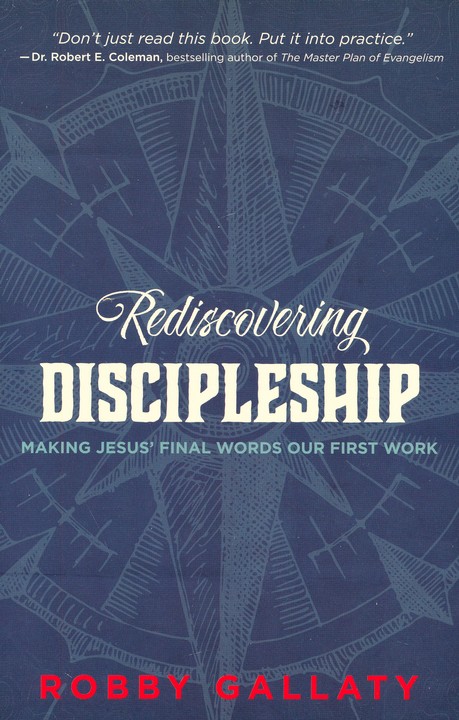
Review of Rediscovering Discipleship

Summary

“Discipleship” is a word that is used often in churches but not as often used as it ought to be. Robby Gallaty’s book, Rediscovering Discipleship walks through the biblical idea of discipleship, the historical examples of it, the types of discipleship, and the elements that ought to be included in the process. Gallaty believes that many churches do not focus on discipleship because their leaders do not understand it or were never truly discipled themselves. He says that it is impossible to be led somewhere you have never been or to teach something you have never learned. 

Gallaty’s book is written in two parts. Part 1 is titled “Know the Man Before You Go on the Mission,” and part 2 is titled “The Method of Making Disciples.” In the first half of the book, Gallaty teaches what discipleship looked like in the context of the Jewish culture when Jesus was on earth, how the early church fathers incorporated discipleship into their ministry, and why there is a discipleship deficit today. 

Gallaty teaches what discipleship looked like in the context of the Jewish culture when Jesus was on earth, how the early church fathers incorporated discipleship into their ministry, and why there is a discipleship deficit today. 

Jews were placed in school at a young age and began to learn from the rabbis about the Torah and the Jewish Bible. As they got older, the lessons became more rigorous. By the age of fifteen, boys were either chosen by rabbis for more training or went to work. Understanding this helps us understand who Jesus’s disciples were. They were young men, more than likely all under eighteen except for Peter who was married (75). Jesus taught them wherever they went and taught them in four phases: he showed them, then he allowed them to help, then they did the work with Jesus’s help, and finally he sent them out to minister themselves (36). 

Gallaty then explains how some of the church fathers demonstrated discipleship. Augustine created a community of apprentices around him who he taught and studied with so they could also learn to make disciples (89–91). Whenever Augustine traveled, he always brought a student with him to watch and learn. Another pastor who Gallaty writes about is Jonathan Edwards. Edwards knew that “you can’t expect from others what you don’t emulate yourself” (99). 

Finally, Gallaty points out that the church has not discipled in the way they should because there has been a misunderstanding about whose job discipleship is. Since the King James Bible was written, the mindset of discipleship was that disciple-making was the role of the pastor and those trained in the Bible (120–21). However, we must come to the understanding that the Great Commission makes disciple-making a role that all Christians must fulfill. We are all to disciple and evangelize.

In part 2, Gallaty talks about the difficulties churches face when trying to make disciples and steps they can take to better equip themselves when making disciples.

Gallaty describes modern society as “McChristian Culture” (130). We live in such an on-demand culture where we do not have to wait long on anything, that we have attempted to apply that to the church as well. We want simple multi-week courses in discipleship that are done in eight to twelve weeks and that we think have accomplished disciple-making. However, discipleship is a slow process that is developed over time and involves constant care and checking in. In teaching lessons, Gallaty encourages us to remember them, reflect on them, retell them, and then repeat the process (133). In doing this, we are teaching and empowering others to be able to replicate the process. 

In his last chapter, Gallaty gives an acronym for his five principle elements to discipleship: MARCS. MARCS stands for Missional, Accountable, Reproduceable, Communal, and Scriptural. The first principle, “Missional,” is about living your life looking for opportunities to spread the gospel (184–91). We must pray for boldness and that the Spirit will allow us to be open to his moving. Second, “Accountable” means being committed to bettering our walk with God with others (191–94). We want to see the people we are walking side-by-side with to grow and be truthful, so we must grow and be truthful. Third, “Reproducible” means that we are setting our disciples up to carry on the lessons they have learned (194–97). Gallaty wrote, “The discipleship process is not complete until the mentee becomes a mentor to others” (197). Fourth, “Communal” means being in community surrounded by others with the same goal (197–200). Finally, “Scriptural” means we base the lessons we learn on God’s Word (201–2). The Bible is the ultimate resource to learn from.

Personal Reflection

Gallaty’s book was an easy read with relevant and practical information. His method of outlining the cultural context of discipleship in the Jewish community gave better context to the way that Jesus did discipleship. I knew that the disciples were more than likely young men, but I did not fully understand the significance of the fact that they had jobs when Jesus called them. This meant that they had not been picked by other rabbis to be trained. This meant that Jesus was really picking normal, everyday people. Jesus’s age when he started his ministry was also significant because that is the age when Jewish rabbis began their ministry. 

The author gave significant evidence that discipleship is a practice that was around even after Jesus’s time but that was lost over time. He did point out reasons for its decline and gave reasons as to why he thought it ought to be practiced and practiced properly. His steps on how to work on the process, what type of groups to use, and practices to implement are practical and easy to understand. He does, however, point out that it is a lengthy process and a difficult one to execute.

Ministry Takeaways

Gallaty’s writing on discipleship challenges anyone in ministry to evaluate whether they are actually discipling or whether they are just evangelizing to those already saved. “You can’t disciple an unbeliever” (163). “Discipleship is intentionally equipping believers with the Word of God through accountable relationships empowered by the Holy Spirit in order to replicate faithful followers of Christ” (155). If the goal of discipleship is looking like Christ and equipping others to go make disciples, an unbeliever cannot be discipled because they do not have the Holy Spirit. We evangelize to the unbeliever, and we disciple the believer. The takeaway is to choose a group of individuals you can pour into and grow with. Jesus gave us the Great Commission and when we are not actively discipling, we are not fulfilling the Great Commission. I believe the other part of that challenge is remembering that the goal is to enable those we disciple to repeat the process with others. We often just focus on pouring into people so that they grow in their relationship with God, forgetting that the purpose is for them to realize that they too can fulfill the Great Commission and make disciples.


Work Reviewed 

Gallaty, Robby. Rediscovering Discipleship. Grand Rapids: Zondervan, 2015.


Nathaniel Miller is the Pastor of Music & Children at Emmanuel Baptist Church in Parrish, Florida. He is an alum of Southeastern University and Southeastern Baptist Theological Seminary. He and his wife, Heidi, have one son, Jedidiah.